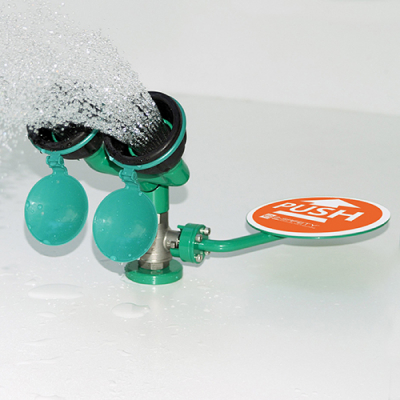
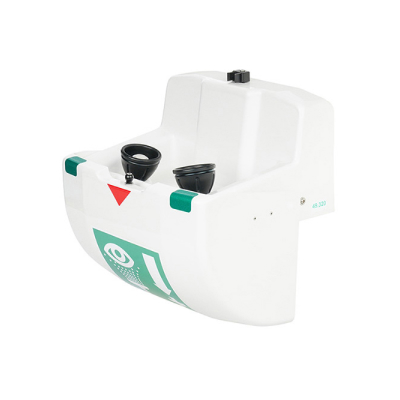
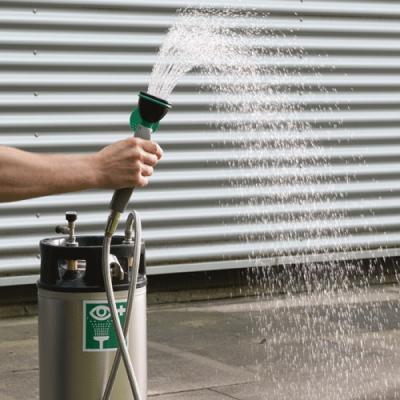
Eye showers are mandatory first aid facilities for workplaces where employees may come into contact with hazardous substances, acids, alkalis, heat, flames and also extreme dirt. Eye showers are used to rinse the eyes and face in emergencies.
Where chemicals, hot media or dust are used, eyes are particularly at risk. An easily accessible eye wash can prevent serious injuries or permanent damage in an emergency.
Frequently asked questions
What types of installation are available for hand-held eye wash stations?
Table mounting Wall mounting Wall and table mounting Diagonal mounting.
What should be considered when using an eye wash in a first aid situation?
When rinsing the eye in a first aid situation, the eye wash should not come into direct contact with the contaminated eye or the area around it. The black rubber guard on the B-SAFETY eye wash is only intended to protect against impact injuries. An optimal rinsing effect is achieved at a distance of approx. 150 mm. The diameter of the spray cone at this height is approx. 80 mm. It is recommended to hold the eye open with both hands during use. Seek medical attention!
The shower head or shower heads should be emptied after each use if possible by holding the shower upside down. This prevents water from standing in the shower head and minimises the possibility of germs developing.
How should one behave in an emergency?
In the event of an accident involving burns or contact with hazardous liquids or gases, it is important to:
Rinse the affected areas of the body immediately with plenty of water!
Remove affected clothing that is not stuck to the skin as quickly as possible!
Depending on the severity of the chemical burn, the eyes should be rinsed for up to 15 minutes in accordance with BG guidelines!
In case of eye injuries, hold the eyelids open while rinsing!
Call an ambulance as quickly as possible and seek medical advice!
Continue rinsing during transport and in the first-aid room! This requires eye wash bottles, which you can find in our online shop at the following link: https://b-safety24.com/augenspuelflaschen.html
Inform the doctor about the substance in question and advise them of possible countermeasures!
What standards and guidelines apply to eye wash stations?
Eye wash stations must comply with EN 15154-2:2006 in Europe and ANSI Z358.1-2014 in the USA. Other national standards may also apply. In addition, company-specific standards may need to be taken into account when selecting an eye wash station.
What volume flow is required for an eye wash?
EN 15154-2:2006 requires a minimum flow rate of 6 litres per minute for eye wash stations for all areas of application, regardless of the number of outlets. The spray height should be between 100 and 300 mm before the spray collapses. B-SAFETY eye wash stations are equipped with high-performance shower heads that deliver a particularly soft water spray, which is optimised for rinsing chemicals out of the eye.
ANSI Z358.1-2014 distinguishes between eye wash stations and eye/face wash stations. Eye wash stations require a minimum flow rate of 1.5 litres/minute or 0.4 GPM, while eye/face wash stations require a minimum flow rate of 11.4 litres/minute or 3 GPM.
B-SAFETY eye showers have different flow rates depending on the number of high-performance shower heads:
Eye wash with shower head: 7 litres/minute (1.8 GPM)
Eye wash stations with two shower heads: 14 litres/minute (3.6 GPM)
chemicals
Protection against corrosive liquids
Heat & Steam
Immediate assistance for scalding injuries
metal shavings
Removal of particles in the eye
Vapours & aerosols
Quick rinsing in case of irritation
Frequently asked questions
Do you have any further questions? Take a look at our FAQ.